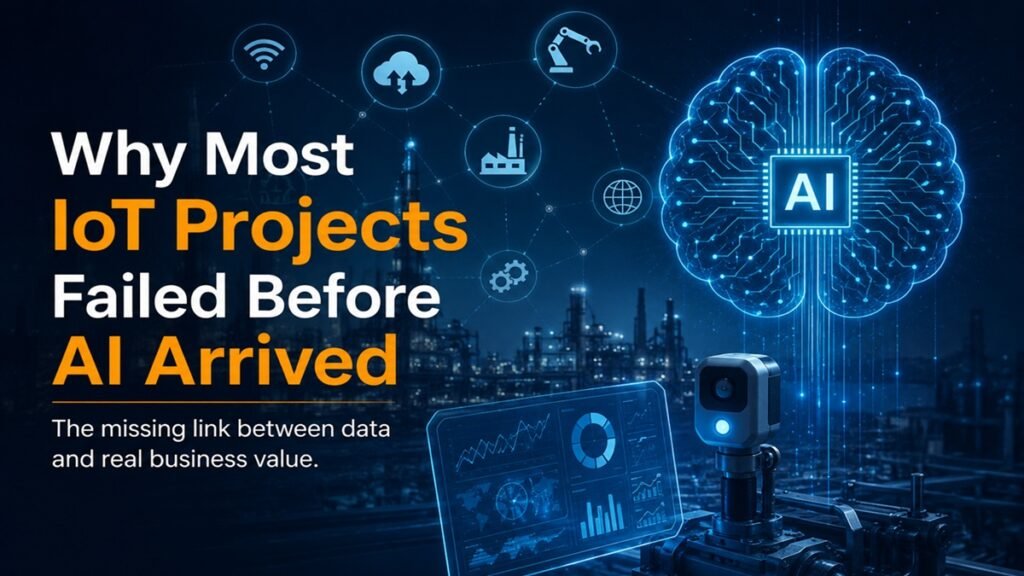
Why Most IoT Projects Failed Before AI Arrived
For years, the Internet of Things (IoT) was positioned as the next major technological revolution.
Businesses invested heavily in connected sensors, smart equipment, remote monitoring systems, and real-time telemetry solutions. Technology vendors promised unprecedented visibility into operations, while industry experts envisioned a future where every machine, vehicle, and asset would be connected and continuously monitored.
Despite the excitement and significant investment, many organizations discovered that the results did not always match expectations.
The problem was not the technology itself.
The real challenge emerged after the data started flowing.
The Great Data Collection Era
The first wave of enterprise IoT adoption focused primarily on connectivity.
Organizations raced to deploy sensors, connect devices to cloud platforms, and create dashboards capable of displaying thousands of data points in real time. Success was often measured by the number of connected assets rather than by measurable business outcomes.
In theory, increased visibility should have enabled better decisions.
In practice, many businesses found themselves overwhelmed by information.
Operations teams received dashboards. Managers received reports. Executives gained access to analytics portals.
Everyone had access to data.
Few had access to meaningful answers.
The result was a growing gap between information availability and decision-making effectiveness.
Visibility Doesn’t Automatically Create Value
One of the most misunderstood aspects of IoT adoption is the assumption that collecting data automatically creates business value.
In reality, collecting data and effectively using data are entirely different challenges.
A manufacturing facility may monitor equipment performance every second of the day. A logistics company may track the location and status of every vehicle in its fleet. A smart building may generate millions of environmental readings each month.
However, visibility alone does not tell decision-makers what requires immediate attention.
When hundreds or even thousands of metrics change simultaneously, identifying meaningful patterns becomes increasingly difficult.
As a result, many organizations deployed sophisticated monitoring systems while still relying on human teams to manually interpret what was happening across operations.
The technology generated awareness.
It did not always generate action.
The Dashboard Problem
For much of the past decade, dashboards became the default response to growing volumes of operational data.
When organizations accumulated more information, they created more reports.
When reports became difficult to interpret, they built additional layers of analytics.
Unfortunately, this often created a new problem.
The dependency on human interpretation continued to grow.
Someone still needed to determine:
- Which anomaly actually mattered.
- Which trend required intervention.
- Which asset was at risk of failure.
- Which operational issue deserved the highest priority.
The data existed.
The decision-making bottleneck remained.
Many IoT initiatives reached a point where organizations had complete visibility into operations but lacked efficient mechanisms to transform that visibility into timely action.
Why AI Changes the Equation
Artificial intelligence addresses a challenge that traditional IoT systems alone could never fully solve.
Instead of simply presenting information, AI systems can analyze vast amounts of operational data and identify patterns that may not be immediately visible to human operators.
The true value of AI is not that it produces more information.
The value lies in helping organizations determine what deserves attention.
Rather than asking employees to review thousands of sensor readings, businesses can focus on the handful of events most likely to affect operations.
Instead of monitoring every machine equally, maintenance teams can prioritize assets showing early indicators of failure.
Instead of reacting after problems occur, organizations can identify potential risks before they develop into costly disruptions.
In many situations, AI is not replacing human decision-making.
It is reducing the amount of noise surrounding it.
This allows decision-makers to spend more time solving problems and less time searching for them.
Predictive Intelligence Replaces Reactive Operations
One of the most significant benefits of combining AI with IoT is the transition from reactive to predictive operations.
Historically, many organizations discovered problems only after failures occurred.
Equipment would break down.
Production would stop.
Service interruptions would affect customers.
Only then would teams investigate the underlying cause.
AI-powered analytics change this model by continuously evaluating sensor data and identifying warning signs before failures become visible.
For example, subtle changes in vibration patterns, temperature fluctuations, power consumption, or operating behavior may indicate developing issues long before a machine experiences a breakdown.
By recognizing these signals early, organizations can schedule maintenance proactively, reduce downtime, and extend asset lifecycles.
The result is not simply more data.
It is better operational outcomes.
The Same Lesson Applies Beyond IoT
Interestingly, the challenges that limited many IoT projects reflect a broader trend occurring throughout modern workplaces.
Organizations have spent years accumulating more software, more automation, and more business intelligence tools. Yet technology alone has never guaranteed better outcomes.
Leadership, prioritization, and human judgment remain essential components of effective decision-making.
The same reality is becoming increasingly evident as AI expands across business functions. While technology can accelerate analysis and automate repetitive tasks, accountability and strategic direction still belong to people. That’s one reason discussions around AI is rewriting the workplace continue to focus on the role of leadership rather than automation alone.
Organizations that successfully adopt emerging technologies understand that software can support decisions, but it cannot replace responsibility.
The Real Lesson From the IoT Era
Looking back, many IoT initiatives did not struggle because sensors were ineffective or because connectivity was overhyped.
They struggled because organizations assumed that access to information would automatically create intelligence.
It does not.
Data can reveal what is happening.
Understanding why it matters and determining what action to take next is a separate challenge entirely.
For years, that gap limited the value businesses could extract from their IoT investments.
Artificial intelligence is beginning to close that gap.
Not by collecting more information, but by helping organizations identify which information deserves attention in the first place.
As AI and IoT continue to converge, businesses have an opportunity to move beyond simple monitoring toward genuine operational intelligence. The organizations that succeed will not necessarily be those with the most sensors or the largest datasets. Instead, they will be the ones that can transform information into action, insights into decisions, and visibility into measurable business value.
That may ultimately become the most important lesson of the entire IoT journey.