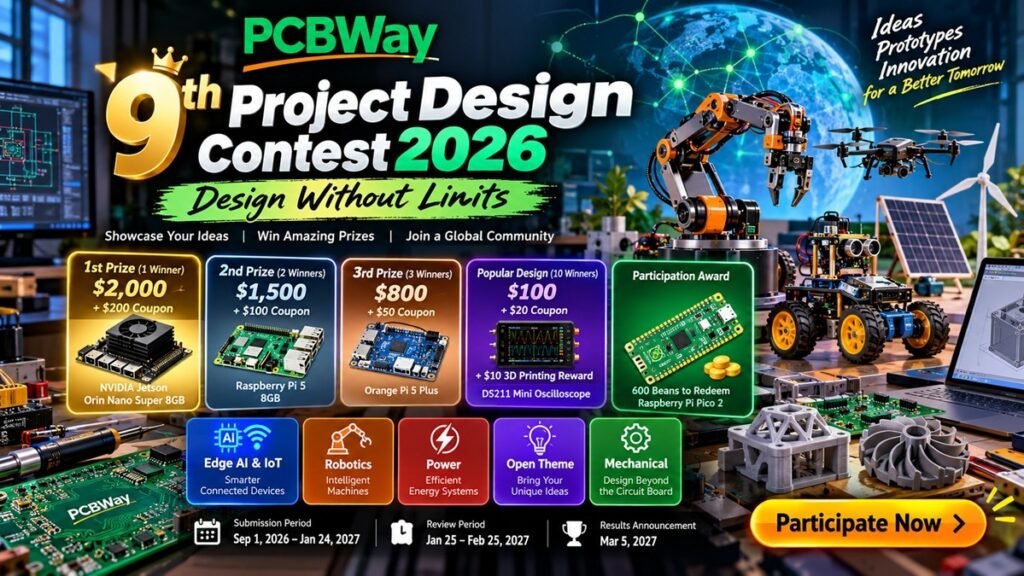
PCBWay 9th Project Design Contest 2026: A Global Opportunity for IoT, Robotics and Hardware Developers
The next big innovation in electronics could start with a simple idea, a development board, or a custom-designed PCB. For makers and engineers who enjoy turning concepts into working hardware, the PCBWay 9th Project Design Contest 2026 offers an opportunity to present their creations to a global engineering community.
Organized by PCBWay under the theme “Design Without Limits,” this competition invites developers, students, electronics enthusiasts, and hardware innovators to submit original projects across five engineering categories. From intelligent IoT devices and autonomous robots to efficient power systems and mechanical designs, the contest celebrates practical creativity and technical problem-solving.
With cash prizes reaching $2,000, development hardware, PCBWay coupons, and community recognition, this year’s contest is worth exploring if you are working on an electronics or embedded systems project.
Official contest page: PCBWay 9th Project Design Contest 2026
PCBWay Project Design Contest 2026: Key Dates
The competition provides a submission window that allows participants to prepare their designs, document their development process, and present their work.
| Event | Date |
|---|---|
| Submission begins | September 1, 2026 |
| Submission deadline | January 24, 2027 |
| Project review | January 25 – February 25, 2027 |
| Results announcement | March 5, 2027 |
As of October 2026, submissions are open. Developers should review the official rules and submit their projects before the January 24, 2027 deadline.
Five Categories for Different Types of Engineering Projects
A major advantage of this competition is its range of themes. Participants can select a category that fits their project’s primary purpose rather than forcing every idea into a single engineering discipline.
1. Edge AI and IoT: Build Intelligent Connected Hardware
IoT development increasingly combines embedded electronics, wireless connectivity, sensors, and intelligent data processing. The Edge AI and IoT category is a natural fit for projects exploring these technologies.
Ideas worth considering include:
- ESP32-based home automation and monitoring systems.
- Smart agriculture and soil-moisture monitoring devices.
- Wireless environmental sensor networks.
- Edge AI systems that process sensor data locally.
- Custom microcontroller boards and sensor-interface PCBs.
- Low-power monitoring devices for industrial applications.
For example, an ESP32-based energy monitoring system could measure electrical parameters, send readings to a dashboard, and trigger alerts when unusual consumption is detected. A well-planned PCB could integrate the controller, communication module, sensor interfaces, and power-management circuitry.
The strongest presentation should explain the problem, system architecture, implementation, and testing results—not simply list the components used.
2. Robotics: Combine Embedded Systems with Motion Control
Robotics brings together electronics, firmware, mechanical design, and control engineering. This category provides a platform for projects that demonstrate how these elements work together.
Potential ideas include autonomous mobile robots, robotic arms, obstacle-avoidance systems, motor controllers, and industrial automation prototypes.
A particularly useful project might combine an embedded controller, distance sensors, motor drivers, and a custom PCB to create a robot capable of navigating a defined environment.
Include a demonstration video, circuit diagrams, and an explanation of the control logic wherever possible. These details help readers understand both the practical result and the engineering behind it.
3. Power: Design Better Energy Systems
Reliable power management is essential for embedded devices, robotics, and IoT products. The Power category is relevant to developers working on energy conversion, battery systems, charging electronics, and power efficiency.
Possible projects include:
- Battery management systems.
- Solar charging controllers.
- DC-DC converter designs.
- Energy monitoring modules.
- Battery-powered IoT devices.
- Power-distribution and protection circuits.
For instance, a solar-powered IoT node could combine a charging circuit, battery protection, voltage monitoring, and low-power firmware to operate for extended periods without a conventional power supply.
Document component selection, calculations, measured performance, and safety precautions. For projects involving hazardous voltages or high-current batteries, appropriate protection and safe testing practices are essential.
4. Open Theme: Present an Unconventional Idea
Not every project fits neatly into IoT, robotics, power, or mechanical engineering. The Open Theme provides an option for original designs that do not naturally belong in another category.
This could include custom development hardware, electronic instruments, experimental communication systems, or other innovative engineering projects.
Choose the category that best represents the purpose of your design and confirm its eligibility under the official contest rules.
5. Mechanical: Improve the Physical Side of Hardware
Successful hardware products require more than a working circuit. Enclosures, mounting systems, structural components, and mechanical assemblies can determine how easily a device can be manufactured, assembled, and used.
The Mechanical category includes relevant concepts such as 3D-printed components, CNC designs, drone structures, robot frames, and custom enclosures.
For example, an enclosure designed around a custom PCB can improve component protection, simplify cable routing, and make a prototype more suitable for practical use. CAD models, assembly diagrams, and photographs can help explain the design process.
PCBWay Contest 2026 Prizes
The contest combines cash awards with hardware that can support future development and experimentation.
| Award | Number of winners | Cash prize per winner | Additional rewards |
|---|---|---|---|
| First Prize | 1 | $2,000 | $200 coupon and NVIDIA Jetson Orin Nano Super 8GB Developer Kit |
| Second Prize | 2 | $1,500 | $100 coupon and Raspberry Pi 5 8GB |
| Third Prize | 3 | $800 | $50 coupon and Orange Pi 5 Plus |
| Popular Design Prize | 10 | $100 | $20 coupon, $10 3D-printing reward, and DS211 mini oscilloscope |
PCBWay also lists a participation reward involving 600 Beans, redeemable for a Raspberry Pi Pico 2 in its store, subject to the official eligibility and approval requirements.
Why the Hardware Rewards Matter
The first-prize NVIDIA Jetson Orin Nano Super 8GB Developer Kit can be valuable for developers exploring edge AI, computer vision, and robotics. Raspberry Pi 5 and Orange Pi 5 Plus boards can support Linux-based development, automation, embedded applications, and prototyping.
For electronics enthusiasts, these rewards represent more than prizes: they can become tools for exploring the next project.
All awards remain subject to PCBWay’s official contest terms.
How Are Projects Evaluated?
The contest uses four evaluation criteria:
Project Design — 30%
Judges consider the project’s complexity, creativity, and technical innovation. Explain what makes your approach different and describe the engineering decisions behind the design.
Practical Impact — 30%
Demonstrate the problem your project addresses and the value it could provide. Practical applications, meaningful improvements, and clear use cases help establish its relevance.
Project Documentation — 25%
Provide a detailed explanation supported by photographs, diagrams, schematics, source code, PCB layouts, bills of materials, CAD models, or manufacturing files as appropriate.
Project Popularity — 15%
Community engagement contributes to the overall evaluation. A useful project description and clear demonstration can encourage genuine interest and discussion.
These criteria make documentation an important part of the submission. A working prototype is valuable, but explaining how it works allows others to learn from the design.
How to Enter the PCBWay Contest
Follow these steps to prepare your entry:
- Select an original project. Choose a design that you created or updated during the designated submission period.
- Choose the right theme. Identify which of the five categories best matches your project’s primary purpose.
- Prepare technical documentation. Include a project overview, design explanation, photographs, and demonstration videos where available.
- Attach supporting files. For electronics projects, these might include schematics, PCB layouts, Gerber files, BOMs, and source code. Mechanical projects may include CAD and manufacturing files.
- Submit through PCBWay. Visit the official contest page and use the Participate Now option, or submit an eligible PCBWay Community project through the designated contest-submission process.
- Check your entry carefully. Confirm that your content is original, complete, accurate, and consistent with the contest rules.
The published submission deadline is January 24, 2027. Check the official page for current instructions and any changes to the schedule.
Tips for Electronics and IoT Developers
If you already build ESP32 projects, Arduino prototypes, sensor modules, robotics systems, or custom PCBs, consider presenting your work as a complete engineering project.
Show the complete system. Explain how the hardware, firmware, communication interfaces, and power supply work together.
Include real testing results. Measurements, photographs, and demonstration videos help establish what the prototype can actually do.
Document your PCB design. Explain important design choices, component selection, connector placement, power requirements, and relevant manufacturing considerations.
Make the project reproducible. Where appropriate, share source code, schematics, BOMs, and other files that allow readers to understand or reproduce the design.
Explain the practical use case. Show how the project could solve a problem in home automation, agriculture, industrial monitoring, energy management, education, or another relevant field.
Encourage genuine community engagement. Share the project with other makers and respond to technical questions. Popularity can contribute to evaluation, but it does not replace good engineering and documentation.
Important Rules to Review Before Submission
Participants can submit individual or team projects and may enter multiple original projects under different themes, subject to the official requirements.
Projects must satisfy the originality rules. Copied or plagiarized work can be disqualified, and participants are responsible for respecting third-party intellectual property rights.
Creators retain their intellectual property rights, while submitting a project grants PCBWay permission to showcase and promote it through its website, social media, and promotional materials with appropriate credit, as described in the contest rules.
For team entries, the prize is awarded to the designated team leader, who is responsible for distributing it among the team members. Participation rewards also have eligibility and approval conditions.
Read the full official contest rules before submitting.
Final Thoughts
The PCBWay 9th Project Design Contest 2026 provides an opportunity for hardware developers to share their work, demonstrate technical skills, and connect with a global maker community.
Whether your project involves intelligent IoT sensors, embedded AI, robotics, power electronics, or mechanical prototyping, the five contest themes provide several ways to present your engineering ideas.
The combination of cash prizes, development hardware, and community recognition makes the competition worth considering for developers who want to take their projects beyond the workbench.
If you have an original design ready to showcase, start preparing your documentation and review the entry requirements.
Explore the contest and submit your project: PCBWay 9th Project Design Contest 2026
Submission deadline: January 24, 2027. Please verify the latest dates, prizes, and eligibility conditions on PCBWay’s official contest page.