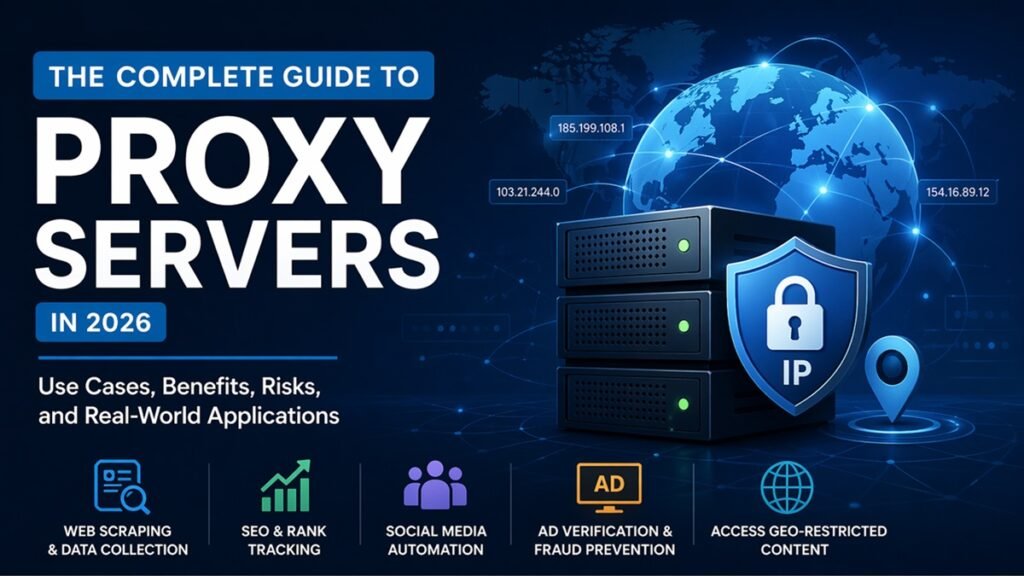
The Complete Guide to Proxy Servers in 2026: Use Cases, Benefits, Risks, and Real-World Applications
Introduction
In today’s data-driven digital ecosystem, managing online identity, accessing global content, and automating workflows have become essential for developers, marketers, businesses, and researchers. One technology that plays a crucial role in all these areas is the proxy server.
Whether you are running SEO tools, building AI datasets, or managing multiple accounts, proxies have become a foundational tool. However, many people still don’t fully understand how they work, where to use them, and what risks are involved.
This guide will explain everything in a simple yet detailed way — from basics to advanced use cases — so you can make informed decisions.
What is a Proxy Server?
A proxy server acts as an intermediary between your device and the internet.
Instead of connecting directly to a website, your request goes through a proxy server, which then forwards it to the destination website.
Simple Flow:
- You → Proxy Server → Website
- Website sees → Proxy IP (not your real IP)
This helps in hiding your identity, bypassing restrictions, and managing multiple connections safely.
Why Proxies Matter in 2026
With increasing restrictions, anti-bot systems, and data privacy concerns, proxies are no longer optional for advanced users.
Key reasons why proxies are important today:
- Websites aggressively block repeated requests
- Geo-restricted content is increasing
- Data scraping is becoming harder
- AI models require large-scale datasets
- Multi-account management needs IP diversity
Without proxies, many of these tasks become either impossible or highly inefficient.
Types of Proxy Servers Explained
Understanding proxy types is essential before choosing any service.
1. Residential Proxies
These are IP addresses assigned by real Internet Service Providers (ISPs).
Advantages:
- Highly trusted by websites
- Low detection rate
- Ideal for scraping and automation
Use case: SEO tools, social media automation, data collection
2. Datacenter Proxies
These are not linked to ISPs but come from cloud servers.
Advantages:
- Very fast
- Cheap
- Easily scalable
Disadvantages:
- Easily detected and blocked
Use case: Bulk operations where detection is not critical
3. Mobile Proxies
These use IPs from mobile carriers.
Advantages:
- Extremely high trust level
- Hard to block
Use case:
- Account management
- High-risk automation
4. ISP Proxies
Hybrid of residential and datacenter proxies.
Advantages:
- Stable
- Faster than residential
- Less detectable than datacenter
5. Rotating vs Static Proxies
- Rotating proxies: IP changes automatically
- Static proxies: Same IP remains fixed
Choice depends on your use case.
How Proxy Servers Work (Technical Overview)
When you send a request:
- Your request is intercepted by the proxy
- Proxy changes your IP address
- Request is forwarded to the target server
- Response comes back through proxy
This process helps in:
- Masking identity
- Avoiding rate limits
- Distributing traffic
Real-World Use Cases of Proxies
1. Web Scraping & Data Collection
For developers building AI models (like MiniGPT), scraping data is essential.
Without proxies:
- You get blocked quickly
- Requests fail
- Data becomes incomplete
With proxies:
- Distributed requests
- Continuous scraping
- Large-scale dataset creation
2. SEO and Rank Tracking
SEO tools often need to check rankings across regions.
Proxies help in:
- Checking real search results
- Avoiding Google bans
- Monitoring competitors
3. Social Media Automation
Managing multiple accounts without proxies leads to:
- Account bans
- IP blacklisting
Proxies solve this by assigning different IPs to each account.
4. Ad Verification
Businesses use proxies to verify:
- Ad placements
- Geo-targeting
- Fraud detection
5. Accessing Geo-Restricted Content
Many services restrict content based on location.
Proxies allow:
- Access to region-specific data
- Testing international platforms
Choosing the Right Proxy Provider
There are many providers in the market, but not all are reliable.
One example platform you can explore is:
👉 https://stableproxy.com/en
When selecting a provider, consider:
1. IP Quality
- Residential > Datacenter (for stealth)
2. Speed
- Important for scraping & automation
3. Rotation System
- Automatic rotation saves effort
4. Location Coverage
- More countries = more flexibility
5. Pricing
- Cheap proxies often mean poor quality
Proxy Use in AI & Machine Learning Projects
For developers like you working on models (MiniGPT, datasets, etc.), proxies are extremely valuable.
Use cases:
- Scraping Wikipedia-scale datasets
- Collecting multilingual data
- Avoiding IP bans during crawling
- Running distributed training pipelines
Without proxies, your training data pipeline will break frequently.
Risks and Limitations of Proxy Usage
Let’s be honest — proxies are powerful, but not risk-free.
1. Legal Risks
Using proxies for:
- Fraud
- Unauthorized scraping
- Bypassing laws
…can lead to serious consequences.
2. Website Detection
Advanced systems can still detect:
- Proxy patterns
- Unusual behavior
3. Cost Factor
Good proxies are not cheap.
Quality comes with price.
4. Performance Issues
- Some proxies are slow
- Shared proxies can lag
Best Practices for Using Proxies
If you want to use proxies effectively:
✔ Rotate IPs properly
✔ Use realistic request headers
✔ Avoid sending too many requests per second
✔ Combine with user-agent rotation
✔ Monitor failures and retry logic
Proxy vs VPN: What’s the Difference?
| Feature | Proxy | VPN |
|---|---|---|
| Encryption | No (usually) | Yes |
| Speed | Faster | Slightly slower |
| Use case | Automation | Privacy |
| Cost | Flexible | Subscription |
👉 For scraping and automation → Proxy is better
👉 For security → VPN is better
Future of Proxy Technology
In 2026 and beyond:
- AI-based detection systems will increase
- Residential proxies will dominate
- Ethical scraping will become important
- Proxy + AI integration will grow
Should You Use Proxies?
YES, if you:
- Build AI models
- Do web scraping
- Work in SEO
- Manage multiple accounts
NO, if you:
- Just browse casually
- Don’t need automation
Final Thoughts
Proxy servers are no longer just a technical tool — they are a core infrastructure component for modern internet workflows.
From AI training to SEO automation, proxies enable scalability, privacy, and efficiency. However, using them responsibly is equally important.
Choosing the right provider, understanding the limitations, and following best practices will ensure you get the most out of this technology.
Disclaimer: Any purchase or use of proxy services is entirely at your own risk, and I take no responsibility for any consequences.